
6 things a modern legal practice management system should definitely do
1. Create a cloud-native foundation that is ready for AI
Cloud-native software is built for the cloud from the outset, rather than accessed remotely through a system designed for a server in your office. It should support secure working across locations, regular updates, growth and easier connections to other tools. Your IT team should be able to manage access, permissions, integrations and changes without maintaining a patchwork of servers and workarounds.
The architecture your legal practice management software is built on, also really matters for AI. Useful AI needs accurate, connected information and clear permissions. Whether your firm uses built-in tools or approved external AI, the system should make it possible to bring those capabilities into real workflows while keeping people in control of important decisions.

2. Include features that follow the whole matter
The essentials should work together: client onboarding and checks, matter information, documents and email, tasks and deadlines, time recording, budgets, WIP, billing, client and legal office accounting, and reporting.
For a fee earner, that means finding what they need and recording work without friction. For operations, it means seeing where a process is stuck. For finance, it means following a matter from work done to cash collected without reconciling disconnected systems. Explore Tessaract's practice management features and why legal accounting belongs in the conversation.

3. Open connections and automation across systems
Your firm should be able to choose the document management, Microsoft 365, identity verification, payments and CRM tools that suit it. Open APIs and supported integrations allow those tools to work with the practice management system, so information can move through the firm without repeated entry.
Workflows should be easy for authorised teams to configure and change. Opening a matter might trigger checks and approvals, create tasks and documents, and update another system when a step is complete. Good automation follows the process across systems while leaving room for exceptions and human judgement.

4. Provide real-time clarity for better decisions
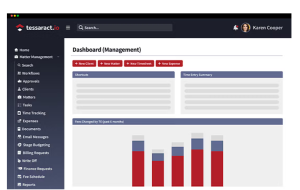
Managing partners should not have to wait until month end to understand performance. Live, role-appropriate dashboards should show WIP, budgets, billing, lock-up, cash flow and matter profitability, with the ability to investigate the matters behind the figures.
The same information helps fee earners act before a budget is exceeded, finance identify billing opportunities, and leaders spot trends across teams and practice areas. The aim is insight people can use while there is still time to change the outcome.

5. Connect finance directly to the matter
The financial story of a matter should not sit in a separate system. Built-in legal accounting connects time, WIP and budgets to billing, client and office accounts, payments and reporting. Finance can follow work from matter opening to cash collection without rekeying or reconciling disconnected records.
That gives fee earners a clearer view of budgets and billing opportunities, while Finance Directors and Managing Partners can see the commercial position of work in progress, not just the final invoice.
Read more about why accounting belongs in practice management.

6. Offer flexibility for whatever comes next
A new office, practice area, billing model or AI capability should not force your firm to rebuild its technology. Look for configurable workflows, flexible reporting, open integrations and a platform that can evolve as your priorities change.
For a deeper evaluation, read our buyer's guide to legal practice management software. Or book a Tessaract demo to see how cloud-native infrastructure, connected workflows and real-time reporting can work together for your firm.

FAQs
Legal tech insights from the Tessaract team

Why law firm data needs to leave the boardroom
Law firm leaders generally feel well informed. In our research with LPM, Mind the Delivery Gap, 80% say leadership has sufficient visibility into performance, while 79% believe their legal management information supports effective decision-making.


Why data driven fee earners are a competitive advantage for law firms
Law firms have never had more data. The challenge is making sure the right people can access the right information at the right time. Our Mind the Delivery Gap research, produced in partnership with LPM, found that 79% of firms believe their management information supports decision making effectively, and 80% say leadership has sufficient visibility into firm performance. However, there is a significant disconnect. Only 14% of respondents said the information they need is always available, and 29% believe providing better insight to fee earners should be an essential investment priority.

When systems don't connect, your IT team becomes the integration layer
They appear as a report that needs to be manually reconciled before it can be trusted. A user raises another support ticket because two systems show different information. A spreadsheet quietly becomes essential to a core process. A member of the IT team is asked to extract, reformat and move data between applications because there is no reliable way for it to flow automatically.

Measuring matter profitability remains a challenge for law firms
Every pricing decision, hiring decision and growth plan depends on understanding one thing: which matters actually make money. Yet our Mind the Delivery Gap research, produced in partnership with LPM, found that only 18% of firms are completely confident in their ability to assess matter profitability. A further 38% say their view is inconsistent or inaccurate, while 67% of leaders report that users experience frustrations with their core systems.

Can your law firm grow without adding more operational pressure?
Growth is firmly on the agenda for mid-size UK law firms. According to Mind the Delivery Gap, our research completed in partnership with LPM. 44% expect moderate organic growth, 33% are pursuing geographic growth and 20% anticipate growth through mergers and acquisitions.

Does legal practice management software need accounting?
When law firms replace their legal practice management software, accounting is increasingly becoming part of the same conversation. Our recent discussions with law firm buyers show firms looking for systems that combine practice management, legal accounting, billing and client money management, rather than treating finance as a completely separate technology decision.

Mid-size law firms flock to the cloud: Why cloud native software is now your best bet
The legal sector is entering a new phase of digital transformation. What was once considered a gradual shift toward cloud technology has now become a clear industry movement.

What is legal practice management software and what should it actually do?
Choosing legal practice management software is one of the most important technology decisions a law firm can make. Yet many firms still evaluate systems based on feature lists alone.

Is technology becoming a deciding factor for potential employees?
Recruiting and retaining talent remains a persistent challenge for mid-size law firms. They are competing with larger firms that can often offer higher salaries, structured career progression, and more established remote working options.

What processes are mid-market law firms automating and where should you start?
One of the greatest benefits of modernising your practice management software is the ability to automate more processes across your firm. Automation helps streamline operations, eliminate workarounds, and reduce manual tasks that otherwise occupy fee earners and support staff’s precious and often, expensive time.