
The law firm profitability playbook
The metrics, reports and commercial behaviours that drive stronger financial performance
In this report
This practical resource explores the metrics and reports law firms need to measure profitability effectively, uncover hidden profit killers and build a stronger commercial culture.
We’ll cover:
- The commercial pressures facing law firms
- The metrics that drive financial performance
- The reports every law firm should build
- Creating a culture of profitability
- Turning insight into action with technology
This paper has been written by:

James Markham
James is a Chartered Management Consultant (MCMI ChMC) with 15 years’ experience working with law firm Managing Partners, COOs and CFOs.
He was previously a member of the UK senior management teams at Hogan Lovells and Dentons, with a directorate at Dentons covering Practice Management, Innovation, Commercial Finance, and Legal Project Management.
James holds an MBA and is a Fellow Chartered Accountant (FCA). He is a certified Design Thinking and Lean Six Sigma practitioner.

Mike Hinchliffe
Mike has over 20 years’ experience in the legal technology sector, working with law firms to modernise operations, improve performance and support sustainable growth. He has held senior leadership roles spanning business management, sales and go-to-market strategy across multiple regions, including supporting US law firms expanding into EMEA.
He combines deep knowledge of the legal sector with extensive experience in running and growing businesses, scaling operations and building high-performing teams.
The profitability metrics that drive financial performance
Monitoring the right law firm profitability metrics helps you understand where value is being created and where profit is being lost. These key financial performance metrics provide greater visibility of matter and client profitability, realisation, utilisation and budget performance, enabling you to make better commercial decisions and protect margins.

Matter profitability
What it measures
The profit generated by an individual matter after accounting for time, costs and write-offs
Why it matters
Revenue alone does not indicate success. Matter profitability helps identify which work creates value and which erodes margin.
Warning signs
High-value matters with low profit, recurring write-offs, budget overruns and scope creep.
Actions you can take
Improve budgeting, review pricing, allocate and delegate work appropriately and monitor profitability throughout the matter lifecycle.

Realisation
What it measures
The percentage of recorded work that is ultimately billed and recovered.
Why it matters
Low realisation means the firm is completing work but failing to capture its full value, reducing profitability.
Warning signs
High write-offs, write-downs, discounts and differences between time recorded and fees billed.
Actions you can take
Improve matter scoping, coach fee earners on time recording and review pricing and discounting practices.

Utilisation
What it measures
The percentage of available time spent on chargeable work.
Why it matters
Indicates how effectively fee earners' time is being used. Both low and consistently excessive utilisation can impact performance.
Warning signs
Low chargeable hours, uneven workloads, declining productivity or consistently overloaded teams.
Actions you can take
Improve resource planning, automate administrative tasks and rebalance workloads across teams.

Matter budget variance
What it measures
The difference between planned and actual time, cost or profitability on a matter.
Why it matters
Helps identify scope creep and delivery issues before they affect profitability.
Warning signs
Matters regularly exceeding budget, declining margins and increasing write-offs.
Actions you can take
Monitor budgets throughout the matter, review exceptions early and discuss scope changes with clients promptly.

Client profitability
What it measures
The profit generated by a client relationship after considering fees, discounts, write-offs and resource costs.
Why it matters
High revenue clients are not always the most profitable. Understanding client profitability supports better pricing and client management decisions.
Warning signs
High-revenue clients with low margins, frequent discounts, aged debt, excessive management time and poor payment behaviour.
Actions you can take
Review engagement terms, improve scope management, monitor client-level profitability and focus resources on the most valuable client relationships.
The hidden profit killers to watch out for using a realisation waterfall
Every matter begins with its full revenue potential. However, profit is gradually lost throughout the lifecycle of the matter through a series of small commercial decisions, operational inefficiencies and delays.
Understanding where that profit leakage occurs, and what actions can be taken to improve it can have a significant impact on client and matter profitability. A Realisation Waterfall is a useful diagnostic tool identify profit leakage.
Many firms will start with a standard rate, or expected fee for a piece of work – shown here as £300.
The first source of leakage can be found between the standard rate and the rate agreed with the client. This may attributable to legacy (we’ve always offered this client a discount) or the confidence of the fee earner leading the pricing discussion. You can identify issues here by comparing the client rate (e.g. £280) with the standard rate and resulting client rate realisation (e.g. 93%).

The reports every law firm should be monitoring
Good reporting should support day-to-day decisions, not simply measure performance. You do not need dozens of dashboards. You need a small number of accurate reports that help improve profitability and strengthen commercial performance.
Revenue and billing
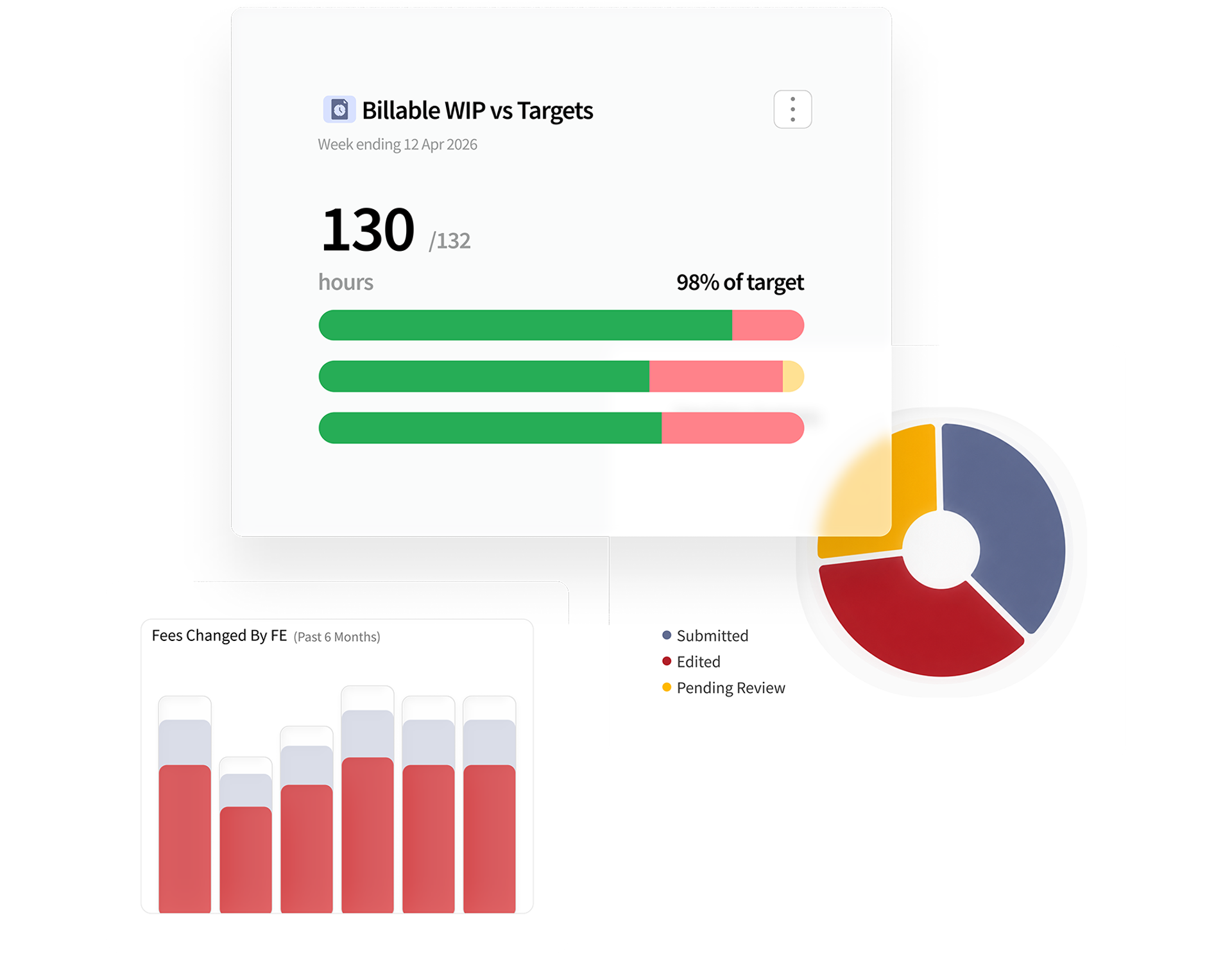
Work in progress (WIP)
Shows the value of work completed but not yet billed. Helps identify where revenue is building up and whether matters are progressing towards invoicing.

Write-offs
Tracks time or fees written off before or after billing. Highlights where profitability is being lost through pricing, scope changes or if something is going wrong with delivery.
People and productivity

Fee earner performance
Compares fee earners across measures such as billed fees, utilisation and realisation. Helps identify high performers and where additional support may be needed.
Fee earner time allocation
Shows how time is split between billable work, business development, training and administration. Helps improve productivity by finding where to reduce non-value-adding activity.
Profitability and financial performance

Matter profitability
Measures the profitability of individual matters by comparing income against time, costs and write-offs. Supports better pricing and delivery decisions.

Practice area profitability
Compares the financial performance of departments or practice areas. Helps leaders understand where the firm generates the greatest returns.

Budget vs actual
Compares financial performance against budgets and forecasts. Enables leaders to identify issues early and take corrective action before targets are missed.
Planning and forecasting

Forecasting and pipeline
Estimates future workload, revenue and resource requirements based on current matters and expected instructions. Supports capacity planning, budgeting and growth decisions.
Top tip!
Give fee earners personal performance reports, and help them understand the metrics. That way, they can act without waiting for finance to intervene. Some useful reports to create for your fee earners are:
- My WIP
- My WIP ageing
- My unbilled time
- My write-offs
- My lockup
- My time allocation
- My matter profitability

Creating a culture of profitability
Every fee earner influences profitability within a law firm. Whilst central management can set policy and direction around commercial behaviours, the success is heavily dependent on the behaviour of individual fee earners.
From how a partner might price or staff a matter, to how a junior might self-edit their time entries or know when to seek help, profit leaks through these day-to-day decisions.
Every time entry affects revenue in terms of:
- Accurately capturing the correct amount of time
- Recording time on a timely basis, and
- Ensuring the narrative is sufficient to enable the partner, and often the client, to make an informed billing decision
Ultimately, a fee earner who understands client and matter profitability will contribute to more profitable clients and matters.

Turning insight into action with the right technology
Commercial awareness is most effective when fee earners can access relevant financial information at the point of decision-making. Legal practice management technology should provide role-appropriate visibility of budgets, WIP, utilisation, realisation and matter profitability, without requiring fee earners to interpret complex financial reports.
Real-time dashboards, automated alerts and connected matter and financial data help firms identify scope creep, pricing pressure and declining profitability early enough to act. Combined with commercial training, this enables fee earners to make better day-to-day decisions, supporting more profitable matters, stronger client relationships and improved firm-wide performance.
FAQs
Legal tech insights from the Tessaract team

Why data driven fee earners are a competitive advantage for law firms
Law firms have never had more data. The challenge is making sure the right people can access the right information at the right time. Our Mind the Delivery Gap research, produced in partnership with LPM, found that 79% of firms believe their management information supports decision making effectively, and 80% say leadership has sufficient visibility into firm performance. However, there is a significant disconnect. Only 14% of respondents said the information they need is always available, and 29% believe providing better insight to fee earners should be an essential investment priority.


When systems don't connect, your IT team becomes the integration layer
They appear as a report that needs to be manually reconciled before it can be trusted. A user raises another support ticket because two systems show different information. A spreadsheet quietly becomes essential to a core process. A member of the IT team is asked to extract, reformat and move data between applications because there is no reliable way for it to flow automatically.

Measuring matter profitability remains a challenge for law firms
Every pricing decision, hiring decision and growth plan depends on understanding one thing: which matters actually make money. Yet our Mind the Delivery Gap research, produced in partnership with LPM, found that only 18% of firms are completely confident in their ability to assess matter profitability. A further 38% say their view is inconsistent or inaccurate, while 67% of leaders report that users experience frustrations with their core systems.

Can your law firm grow without adding more operational pressure?
Growth is firmly on the agenda for mid-size UK law firms. According to Mind the Delivery Gap, our research completed in partnership with LPM. 44% expect moderate organic growth, 33% are pursuing geographic growth and 20% anticipate growth through mergers and acquisitions.

Does legal practice management software need accounting?
When law firms replace their legal practice management software, accounting is increasingly becoming part of the same conversation. Our recent discussions with law firm buyers show firms looking for systems that combine practice management, legal accounting, billing and client money management, rather than treating finance as a completely separate technology decision.

Mid-size law firms flock to the cloud: Why cloud native software is now your best bet
The legal sector is entering a new phase of digital transformation. What was once considered a gradual shift toward cloud technology has now become a clear industry movement.

What is legal practice management software and what should it actually do?
Choosing legal practice management software is one of the most important technology decisions a law firm can make. Yet many firms still evaluate systems based on feature lists alone.

Is technology becoming a deciding factor for potential employees?
Recruiting and retaining talent remains a persistent challenge for mid-size law firms. They are competing with larger firms that can often offer higher salaries, structured career progression, and more established remote working options.

What processes are mid-market law firms automating and where should you start?
One of the greatest benefits of modernising your practice management software is the ability to automate more processes across your firm. Automation helps streamline operations, eliminate workarounds, and reduce manual tasks that otherwise occupy fee earners and support staff’s precious and often, expensive time.

Building the perfect tech ecosystem: Why a best-of-breed stack often beats the all-in-one myth
It’s easy to understand the appeal of the one ring to rule them all software: one partner, one login, one support contact, one magic piece of kit that delivers everything you ever wanted…