
Legal practice management software comparison: Legacy vs cloud-based vs cloud-native
Choosing the right hosting model for your law firm
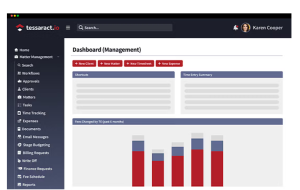
Legal software hosting models at a glance

Legacy software
Traditional on-premise systems installed and managed by the firm.

Cloud-based software
Legacy software adapted to run in hosted cloud environments.

Cloud-native software
Software built specifically for the cloud from the ground up.
Legacy legal practice management software
Legacy systems are typically installed on servers owned and managed by the law firm. Many were originally designed before cloud computing became mainstream and have been adapted over time to support modern requirements.
How it works
The software is hosted on infrastructure managed by the firm, either in its own offices or a dedicated data centre. Internal IT teams are responsible for updates, security, backups and maintenance.
Benefits
- Complete control over infrastructure
- Familiar workflows for long-term users
- Can support highly customised environments
Limitations
- Significant IT overhead
- Ongoing infrastructure costs
- More complex disaster recovery requirements
- Limited remote working flexibility
- Often slower to integrate with modern applications and AI technologies

Cloud-based legal practice management software
Cloud-based systems are often traditional legal applications that have been moved into a hosted environment. Rather than running on servers within the law firm, they are hosted by a third-party provider and accessed remotely.
How it works
The software is hosted in the cloud but typically retains much of its original architecture. Users may access the system through a browser, virtual desktop or remote desktop connection.
Benefits
- Reduced infrastructure ownership
- Improved remote access
- Lower upfront hardware investment
- Easier transition from legacy systems
Limitations
- May retain legacy workflows and user experiences
- Updates can still be disruptive
- Integration capabilities vary significantly
- Often designed around older technology frameworks

Cloud-native legal practice management software
Cloud-native platforms are built specifically for the cloud from the ground up. They are designed around modern web technologies, scalable infrastructure and open integration frameworks.
How it works
Users access the platform through a web browser while infrastructure, security updates and software maintenance are managed by the provider.
Benefits
- Minimal IT overhead
- Automatic updates
- Scalability as firms grow
- Strong integration capabilities
- Better support for legal automation and AI
- Designed for modern remote and hybrid working
Limitations
- Less infrastructure-level customisation
Cloud-native legal practice management systems are increasingly being adopted by firms seeking operational efficiency, flexibility and a foundation for future innovation.

Future proofing your legal technology strategy
Legal practice management software has evolved significantly over the past decade.
Legacy systems provide familiarity and control but can be costly to maintain. Cloud-based platforms reduce infrastructure ownership and support more flexible working. Cloud-native solutions are designed for the modern legal environment, offering scalability, integration flexibility and continuous innovation.
For firms evaluating their next technology investment, understanding the differences between legacy, cloud-based and cloud-native software is an important first step towards building a platform that can support future growth.

FAQs about legal practice management software hosting
Want advice on which cloud solution is best for you?
If you’re looking for practice management software solutions and you’re exploring your hosting options, feel free to reach out to our team. They’re happy to help.
Legal tech insights from the Tessaract team

Why data driven fee earners are a competitive advantage for law firms
Law firms have never had more data. The challenge is making sure the right people can access the right information at the right time. Our Mind the Delivery Gap research, produced in partnership with LPM, found that 79% of firms believe their management information supports decision making effectively, and 80% say leadership has sufficient visibility into firm performance. However, there is a significant disconnect. Only 14% of respondents said the information they need is always available, and 29% believe providing better insight to fee earners should be an essential investment priority.


When systems don't connect, your IT team becomes the integration layer
They appear as a report that needs to be manually reconciled before it can be trusted. A user raises another support ticket because two systems show different information. A spreadsheet quietly becomes essential to a core process. A member of the IT team is asked to extract, reformat and move data between applications because there is no reliable way for it to flow automatically.

Measuring matter profitability remains a challenge for law firms
Every pricing decision, hiring decision and growth plan depends on understanding one thing: which matters actually make money. Yet our Mind the Delivery Gap research, produced in partnership with LPM, found that only 18% of firms are completely confident in their ability to assess matter profitability. A further 38% say their view is inconsistent or inaccurate, while 67% of leaders report that users experience frustrations with their core systems.

Can your law firm grow without adding more operational pressure?
Growth is firmly on the agenda for mid-size UK law firms. According to Mind the Delivery Gap, our research completed in partnership with LPM. 44% expect moderate organic growth, 33% are pursuing geographic growth and 20% anticipate growth through mergers and acquisitions.

Does legal practice management software need accounting?
When law firms replace their legal practice management software, accounting is increasingly becoming part of the same conversation. Our recent discussions with law firm buyers show firms looking for systems that combine practice management, legal accounting, billing and client money management, rather than treating finance as a completely separate technology decision.

Mid-size law firms flock to the cloud: Why cloud native software is now your best bet
The legal sector is entering a new phase of digital transformation. What was once considered a gradual shift toward cloud technology has now become a clear industry movement.

What is legal practice management software and what should it actually do?
Choosing legal practice management software is one of the most important technology decisions a law firm can make. Yet many firms still evaluate systems based on feature lists alone.

Is technology becoming a deciding factor for potential employees?
Recruiting and retaining talent remains a persistent challenge for mid-size law firms. They are competing with larger firms that can often offer higher salaries, structured career progression, and more established remote working options.

What processes are mid-market law firms automating and where should you start?
One of the greatest benefits of modernising your practice management software is the ability to automate more processes across your firm. Automation helps streamline operations, eliminate workarounds, and reduce manual tasks that otherwise occupy fee earners and support staff’s precious and often, expensive time.

Building the perfect tech ecosystem: Why a best-of-breed stack often beats the all-in-one myth
It’s easy to understand the appeal of the one ring to rule them all software: one partner, one login, one support contact, one magic piece of kit that delivers everything you ever wanted…